EEE 131 THX2/Y
Electrical and Electronics Engineering Institute
University of the Philippines
Diliman
2025-11-28
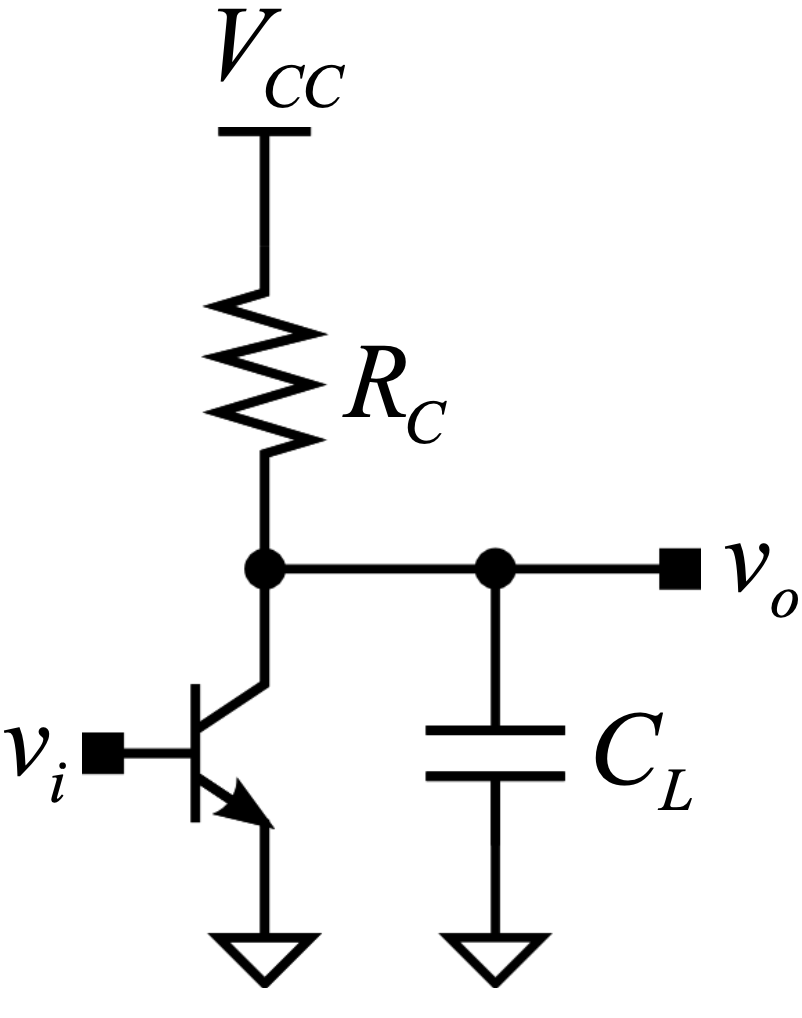
We begin by analyzing the CE amplifier frequency response.
Assumptions:

KCL @ \(v_o\):
\[\frac{v_o}{R_C || \frac{1}{sC_L}} + g_m v_i = 0\]
Then, rearranging, \[A_v(s) = -g_mR_C \left( \frac{1}{1 + sR_C C_L} \right)\]
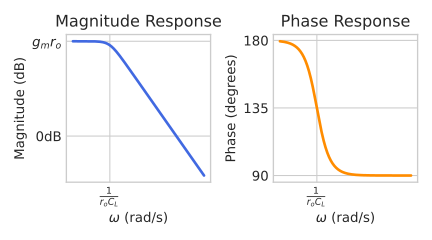
and we have the form
\[A_v(s) = A_0 \left( \frac{1}{1 + s/p_1} \right) \]
\[A_v(s) = -g_mR_C \left( \frac{1}{1 + sR_C C_L} \right)\]
Recalling that \(A_v = -G_m Z_o\), we can solve for the effective transconductance:
\[G_m = \frac{-A_v}{Z_o}\]
\[G_m = \frac{-\left[ \frac{-g_m R_C}{1 + j\omega R_C C_L} \right]}{\frac{R_C}{1 + j\omega R_C C_L}}\]
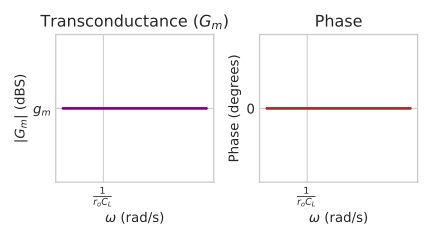
\[G_m = g_m\]
In this simplified model, the transconductance is frequency independent.
\[Z_i = \frac{v_i}{i_i} \bigg|_{v_o=0}\]
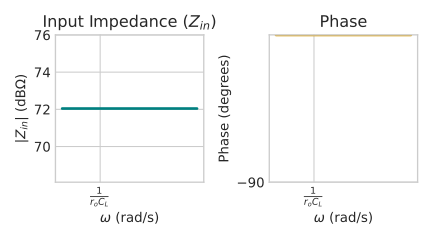
By simple inspection of the small signal model: \[Z_i = r_\pi\]
The input impedance is purely resistive and constant across frequency (in this specific configuration).

We can construct a two-port network representing the amplifier so far:
\[Z_i = r_\pi\]
\[G_m = g_m\]
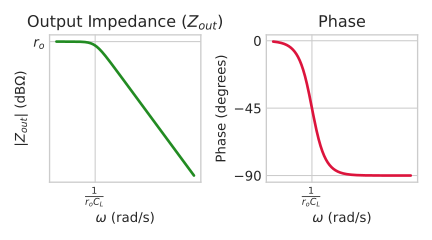
\[Z_o = \frac{R_C}{1 + sR_C C_L}\]
Now we add a source resistance \(R_S\) and a base-emitter capacitance \(C_\pi\).
We must determine how \(v_{be}\) relates to \(v_i\) considering the frequency dependent voltage divider at the input.
Applying voltage division at the input loop:
\[\frac{v_{be}}{v_i} = \frac{Z_\pi}{Z_\pi + R_S}\] where \(Z_\pi = r_\pi \parallel \frac{1}{sC_\pi}\).
\[\frac{v_{be}}{v_i} = \frac{\frac{r_\pi}{1 + s r_\pi C_\pi}}{\frac{r_\pi}{1 + s r_\pi C_\pi} + R_S}\]
Multiplying numerator and denominator by \((1 + s r_\pi C_\pi)\): \[\frac{v_{be}}{v_i} = \frac{r_\pi}{r_\pi + R_S + s r_\pi R_S C_\pi}\]
\[\frac{v_{be}}{v_i} = \frac{r_\pi}{r_\pi + R_S + s r_\pi R_S C_\pi}\]
We factor out \((r_\pi + R_S)\) from the denominator to normalize the DC term:
\[\frac{v_{be}}{v_i} = \frac{r_\pi}{r_\pi + R_S} \left( \frac{1}{1 + s C_\pi \frac{r_\pi R_S}{r_\pi + R_S}} \right)\]
This results in an input attenuation factor \(A_{i}\) and an input pole \(\omega_{p1}\): \[\frac{v_{be}}{v_i} = A_i \frac{1}{1 + j\frac{\omega}{\omega_{p1}}}\] where \(A_i = \frac{r_\pi}{r_\pi + R_S}\) and \(\omega_{p1} = \frac{1}{C_\pi (r_\pi \parallel R_S)}\).
We combine the input section response (\(A_1\)) with the output section response (\(A_2\)).
\[A_v(s) = \underbrace{\left( \frac{v_{be}}{v_i} \right)}_{\text{Input Section}} \cdot \underbrace{\left( \frac{v_o}{v_{be}} \right)}_{\text{Output Section}}\]
\[A_v(s) = \left[ \frac{r_\pi}{r_\pi + R_S} \cdot \frac{1}{1 + j\frac{\omega}{\omega_{p1}}} \right] \cdot \left[ -g_m R_C \cdot \frac{1}{1 + j\frac{\omega}{\omega_{p2}}} \right]\]
Total Gain
\[A_v(s) = A_{mid} \frac{1}{(1 + j\frac{\omega}{\omega_{p1}})(1 + j\frac{\omega}{\omega_{p2}})}\] \[\omega_{p1} = \frac{1}{C_\pi (r_\pi \parallel R_S)}, \quad \omega_{p2} = \frac{1}{R_C C_L}\]
Typically, the output pole \(\omega_{p2}\) is lower frequency than the input pole \(\omega_{p1}\).
The phase response depends on the separation of the poles.
\[\angle A_v(\omega) = 180^\circ - \tan^{-1}\left(\frac{\omega}{\omega_{p1}}\right) - \tan^{-1}\left(\frac{\omega}{\omega_{p2}}\right)\]
Widely Separated If poles are far apart, the phase drops in distinct steps. 
Close Proximity If poles are close, the phase shifts merge, creating a steeper descent. 
We can generalize the two-port parameters to include frequency effects:
Input Impedance \(Z_i(\omega)\) \[Z_i(\omega) = R_S + \frac{r_\pi}{1 + j\omega r_\pi C_\pi}\] Derivation involves simple series/parallel combination of \(R_S, r_\pi, C_\pi\).
Transconductance \(G_m(\omega)\) \[G_m(\omega) = \frac{g_m}{1 + j\omega (R_S \parallel r_\pi) C_\pi} \cdot \frac{r_\pi}{r_\pi + R_S}\] Effective transconductance rolls off due to the input pole.
Frequency Response of CE Amplifier